Introduction
For Australian warehouses and freight operations, industrial packaging pallets are not just a storage base.
They are part of a broader handling system that directly impacts loading speed, racking safety, freight damage rates, labour efficiency, and export compliance.
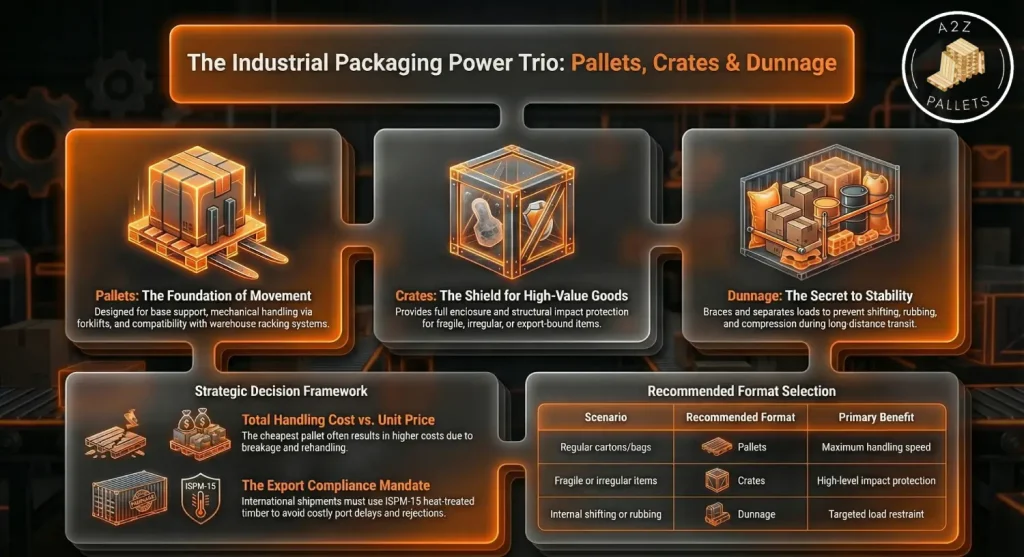
In simple terms, pallets, crates, and dunnage solve different problems at different stages of the supply chain.
A pallet makes goods movable.
A crate protects high-value or irregular items.
Dunnage stabilises and separates loads so they arrive intact.
This distinction becomes critical in Australia. Freight often travels long distances between cities, across mixed climates, and through multiple handling points.
A packaging decision made at the warehouse can influence forklift turnaround, container fill efficiency, damage claims, and even export clearance.
Definition: Industrial packaging pallets are load-bearing platforms designed to support goods during storage, handling, and transport across warehouse and freight networks.
For procurement teams, the real question is not what is cheapest per unit.
The better question is: what packaging format delivers the lowest total handling and damage cost?
Understanding Industrial Packaging: Pallets, Crates & Dunnage
Industrial packaging is the combination of materials and load-support systems used to protect, move, stack, and ship goods in commercial and industrial supply chains.
In most warehouse environments, the three core categories are:
- Pallets – for base support and mechanical handling
- Crates – for enclosure and impact protection
- Dunnage – for bracing, spacing, blocking, and load restraint
These components are rarely used in isolation.
A typical industrial load may:
– Sit on a timber pallet
– Be enclosed in a crate
– Use internal dunnage to prevent movement
This combined approach is common in heavy industry, machinery supply, spare parts distribution, and export packing.
Key Roles of Pallets, Crates, and Dunnage in Australian Warehouses
In an Australian warehouse, pallets mainly support forklift access, racking compatibility, picking efficiency, and outbound staging. They are the default handling unit for FMCG, industrial parts, chemicals, hardware, and bulk distribution.
Crates play a different role. They are used where goods need enclosure, structural protection, tamper resistance, or custom fitment. This is especially relevant for fragile equipment, export consignments, fabricated components, and items with awkward dimensions.
Dunnage is often overlooked, but it directly affects damage prevention. It is used to separate products, stop shifting, absorb shock, maintain spacing, and protect surfaces. In freight and container packing, dunnage can be the difference between a stable load and a costly claim.
Australian operating conditions make all three more important:
- Long interstate freight legs increase movement and vibration risk
- Coastal humidity and inland heat can affect timber performance and moisture content
- Port and container handling adds repeated loading pressure
- Export shipments may require ISPM-15 compliant heat-treated timber
- Warehouse labour shortages increase the value of faster, safer handling systems
Insight: A pallet solves movement. A crate solves protection. Dunnage solves stability. Most damage events happen when one of those three functions is missing.
Common Differences and Uses in Packaging and Shipping
Although buyers often group them together, pallets, crates, and dunnage should be assessed by function, not material alone.
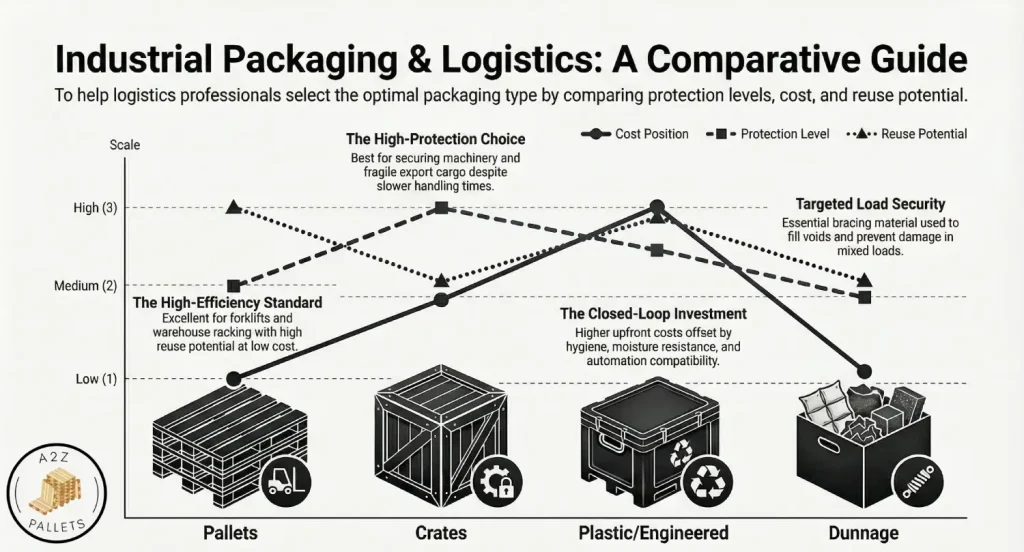
| Packaging type | Primary purpose | Best for | Protection level | Handling profile | Typical cost position | Reuse potential |
|---|---|---|---|---|---|---|
| Pallets | Support and move unit loads | Cartons, bagged goods, drums, bulk warehouse stock | Moderate | Excellent for forklifts, pallet jacks, racking | Low to medium | High if good quality |
| Crates | Enclose and protect goods | Machinery, fragile items, export cargo, irregular products | High | Slower to build, but secure in transit | Medium to high | Medium to high |
| Dunnage | Brace, separate, and secure items | Machinery, steel, containers, mixed loads, void filling | Targeted protection | Used with other packaging formats | Low per piece, high value in damage prevention | Varies by material |
| Plastic or engineered alternatives | Hygiene, repeated loops, moisture resistance | Food, pharma, export loops, clean environments | Moderate to high | Consistent dimensions, often automation-friendly | Higher upfront | High in closed-loop systems |
A simple rule applies in shipping:
- Use pallets when the load is regular and needs efficient handling
- Use crates when the item needs external protection or custom containment
- Use dunnage when the main risk is movement, rubbing, compression, or internal instability
This is where the phrase pallets crates dunnage should be understood as a system, not a keyword bundle. Buyers who treat them as interchangeable often pay more later in repacking, breakage, and freight disputes.
Types of Industrial Packaging Pallets Used in Australia
Different pallet types are used depending on load weight, handling method, and industry requirements.
Common pallet types include:
– Pine (Softwood) Pallets – Lightweight, cost-effective, widely used in domestic freight and one-way shipments
– Hardwood Pallets – Designed for heavy loads, high durability, and repeated use in industrial environments
– Skids (Machinery Bases) – Pallet-like structures without bottom deck boards, used for heavy equipment and machinery transport
– Closed Deck Pallets – Provide full surface support for smaller or fragile goods
– 4-Way Entry Pallets – Allow forklift access from all sides, improving handling efficiency
For most warehouse operations, the choice depends on load weight, reuse cycle, and handling frequency.
Insight: Hardwood pallets are preferred for heavy loads, while softwood pallets are more economical for high-volume movement.
Choosing the Right Packaging: Pallets, Crates or Dunnage
Choosing the Right Packaging: Industrial Packaging Pallets, Crates or Dunnage
Selecting packaging for industrial operations should start with the load profile, not with supplier stock availability. The correct solution depends on what is being moved, how often it is handled, whether it is exported, and how much damage risk the business can tolerate.
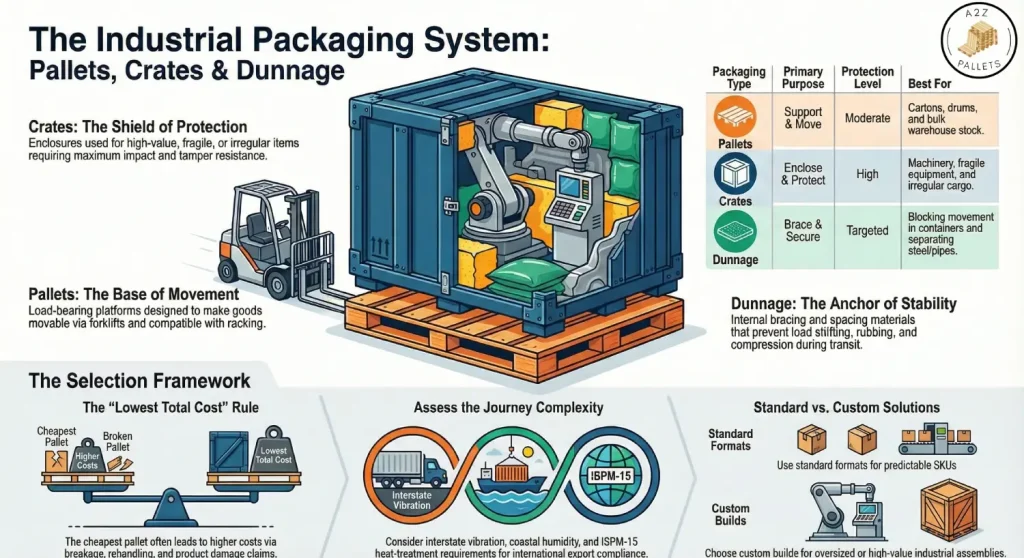
Standalone takeaway: The cheapest pallet is rarely the lowest-cost pallet once breakage, rehandling, and product damage are counted.
Factors to Consider for Business Needs
Most B2B buyers should assess packaging against five operational questions:
- What is the weight and load distribution?
Dense loads such as metal parts, castings, drums, and bagged materials place different stress on a pallet than light cartons. Uneven weight often calls for stronger deck design, thicker bearers, or added dunnage. - How will it be handled?
Forklift-only movements differ from mixed forklift and pallet jack traffic. If the load moves through racking, cross-docking, container stuffing, and customer unloading, the packaging needs to survive multiple touchpoints. - What is the transit environment?
Local metro delivery is one thing. Interstate linehaul, regional freight, port storage, and export containers are another. Vibration, moisture, and stacking pressure all increase with journey complexity. - Does the item need external protection or internal restraint?
If the item is fragile, high-value, or irregularly shaped, a pallet alone may not be enough. A crate or custom dunnage system may reduce risk far more effectively than upgrading pallet timber alone. - Is this a one-way shipment or a returnable loop?
One-way exports often justify different materials and compliance treatment than repeat-use warehouse loops. Closed-loop transport can support higher upfront cost if reuse rates are reliable.
Factors to Consider for Business Needs
Use this practical decision framework when choosing between formats:
- Choose pallets when:
- Goods are cartonised, bagged, or unitised
- Fast forklift handling matters
- Stock will sit in racking or staging areas
- Loads are relatively regular in shape
- Unit cost control is a priority
- Choose crates when:
- The item is fragile, valuable, export-bound, or irregular
- Surface damage or impact must be minimised
- The shipment may face rough handling
- The buyer needs a custom internal fit-out
- The cargo cannot be safely stacked bare on a pallet
- Choose dunnage when:
- Product movement inside the load is the main risk
- Multiple items need spacing or separation
- Machinery, steel, pipe, or fabricated goods need blocking
- Container restraint is required
- Surface rubbing, compression, or load shift is likely
This framework is especially useful for procurement teams balancing cost vs durability trade-offs. A stronger pallet may add modest cost. A crate may cost more upfront but prevent a major damage event. Dunnage is often the lowest-cost intervention with the highest protection value.
Need help selecting the right packaging format?
If you’re comparing pallets, crates, and dunnage for your operations, reviewing real-world specifications and use cases can make the decision clearer.
Explore different pallet types, load capacities, and industrial use cases to see what fits your workflow best.
Comparing Standard vs Custom Solutions
Standard packaging works best when the product range is stable, dimensions are consistent, and replenishment speed matters. It is usually the right choice for general warehousing, wholesale distribution, and routine outbound freight.
Custom packaging becomes worthwhile when product geometry, handling risk, or customer requirements make standard formats inefficient. That is common in engineering, mining supply, industrial equipment, electrical cabinets, fabricated assemblies, and export projects.
Here is a simple standard vs custom framework:
- Standard solutions are best when:
- SKUs are predictable
- Lead time matters more than precision fit
- Volume is steady
- The goods are not unusually fragile
- You need easy reordering and broad supplier availability
- Custom solutions are best when:
- Products are oversized, awkward, or high-value
- Export compliance or client specifications are strict
- Damage costs are materially higher than packaging cost
- Space efficiency in containers matters
- You want a packaging design matched to load points and restraint needs
A good example is industrial pumps or gearbox assemblies. A standard pallet may carry the weight, but a custom base with timber dunnage blocks and a crate can protect protrusions, maintain centre-of-gravity stability, and reduce freight damage.
Insight: Standard packaging lowers purchasing complexity. Custom packaging lowers operational risk. The right choice depends on which cost matters more in your supply chain.
Timber Dunnage: Protection and Application
Timber dunnage remains one of the most practical packaging components in industrial logistics because it is versatile, repairable, and easy to adapt at warehouse level.
For many buyers, dunnage is the unseen element doing the most important work. It absorbs movement, keeps products separated, prevents direct contact, and creates stable load geometry where none existed before.
What is Timber Dunnage and When Is It Used?
Definition: Timber dunnage is timber used to brace, block, separate, support, or protect cargo during storage and transport.
It may appear as blocks, strips, spacers, bearers, chocks, cleats, or internal bracing members. Unlike a pallet, which supports the whole unit load from below, dunnage is usually placed between, around, or under key pressure points of the cargo.
Common applications include:
- Separating steel sections or pipes
- Supporting machinery with uneven base points
- Preventing carton crush in mixed loads
- Stabilising loads inside shipping containers
- Protecting finished surfaces from abrasion
- Creating forklift clearance under awkward items
- Blocking wheels or cylindrical products from rolling
Timber dunnage is widely used in sectors such as:
- Manufacturing
- Mining and resources
- Agricultural equipment
- Metal fabrication
- Building products
- Export packing and project cargo
In export work, buyers must pay attention to ISPM-15. Timber packaging used in international shipments often needs approved heat treatment and marking to reduce biosecurity risk. For Australian exporters, this is not a minor detail. Non-compliant timber packaging can trigger border delays, re-treatment, refusal, or additional cost at destination.
Export Pallets and Compliance for International Shipping
Export shipments from Australia must meet strict biosecurity and packaging standards.
The most important requirement is ISPM-15 compliance, which applies to all timber packaging used in international freight.
Key compliance requirements:
– Heat-treated or fumigated timber
– Proper ISPM-15 stamping and certification
– Pest-free and contamination-free materials
– Compliance with destination country regulations
Failure to meet these standards can result in:
– Shipment delays
– Rejection at port
– Additional fumigation costs
– Supply chain disruption
For export-heavy industries, using compliant industrial packaging pallets is not optional—it is essential.
Insight: Non-compliant pallets can cost more in delays than the entire shipment value.
Advantages in Freight and Logistics
The practical value of timber dunnage is that it improves load control without requiring a complete packaging redesign. That makes it attractive for warehouses dealing with variable industrial stock.
Key advantages include:
- Load stability: reduces shifting during road, rail, and sea transport
- Damage prevention: limits rubbing, impact, and compression
- Flexibility: easy to cut or configure for unusual items
- Compatibility: works with pallets, crates, skids, and containers
- Cost efficiency: often a low-cost way to reduce high-cost freight damage
- Repairability: damaged pieces can often be replaced without scrapping the full unit
In Australian freight, where a load may travel from Melbourne to Perth or Brisbane to regional Queensland, vibration and repeated handling are serious risks. Timber dunnage helps maintain separation and support over that journey.
For logistics managers, this matters because freight claims are rarely caused by a single dramatic event. More often, they result from progressive movement over time. Dunnage directly addresses that issue.
A strong industrial dunnage supplier should be able to advise not just on timber dimensions, but also on load restraint logic, export treatment, moisture considerations, and the operational trade-off between disposable and repeat-use packaging.
Sourcing Pallets, Crates & Dunnage in Australia
Sourcing in the Australian market is less about finding a catalogue and more about finding a supplier model that matches your freight profile, volume pattern, and compliance needs.
The best supplier for metro warehousing may not be the best for regional linehaul or export packing. Buyers should assess capacity, timber quality, repair consistency, lead times, treatment certification, and responsiveness during peak demand.
Bulk Pallets Supply and Wholesale Options
For most warehouses, bulk pallets supply is the main procurement need. The priority is usually reliable replenishment, consistent dimensions, and a clear quality grade.
Common buying options in Australia include:
- New timber pallets for maximum consistency
- Reconditioned pallets for lower cost and general warehouse use
- Heat-treated export pallets for international shipments
- Custom skids and bases for heavy or irregular items
- Pallet pooling systems where appropriate for retail or distribution channels
When evaluating wholesale or contract supply, buyers should ask:
- Are pallet dimensions consistent enough for racking and forklifts?
- What timber grade and nail pattern are used?
- Can the supplier support seasonal volume spikes?
- Do they offer pickup, repair, and recirculation programs?
- Can they supply matching crates or dunnage when needed?
- Do they provide export treatment documentation where required?
This is also where local logistics realities matter. Australian buyers often operate across dispersed sites, from metro DCs to regional depots and project locations. A supplier with only one production point may struggle with urgent replenishment outside its core region.
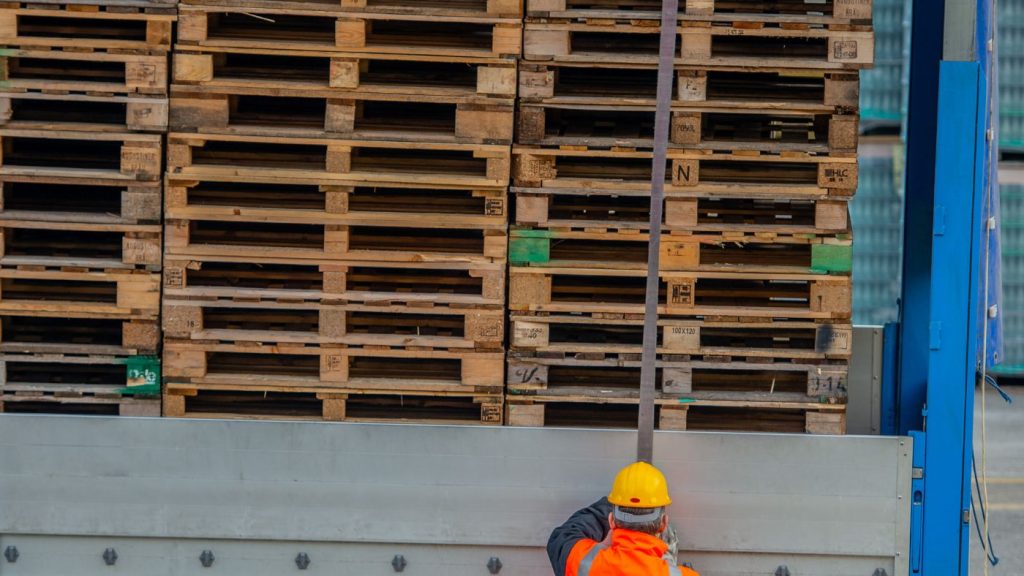
For procurement teams managing multi-site operations, it can be more efficient to consolidate sourcing under one supplier that can cover industrial packaging pallets, crates, and dunnage rather than buying each item separately with mismatched lead times.
A real-world example is a spare parts distributor shipping motors and pump components nationwide. Standard pallets may cover 80 percent of outbound volume. But the remaining 20 percent may need crating or blocking for heavier assemblies. A mixed-capability supplier reduces coordination time and lowers the risk of ad hoc packing decisions on dispatch day.
For high-volume operations, bulk pallets supply agreements help standardise procurement and reduce cost variability.
Businesses dealing with heavy loads, frequent dispatch cycles, or multi-location distribution benefit from consistent pallet specifications and reliable supply continuity.
Working with a scalable supplier ensures availability during peak demand and reduces last-minute sourcing risks.
Eco-Friendly and Recycled Packaging Choices
Sustainability in industrial packaging is most useful when it is tied to measurable operational outcomes. For B2B buyers, that usually means:
- lower breakage
- better reuse rates
- repairability
- reduced disposal cost
- fewer emergency buys
- less material waste over time
Recycled and reconditioned timber pallets are already common in Australia and can be a strong option for internal warehousing, domestic freight, and lower-risk loads. They are often cost-effective, widely available, and suitable for businesses that do not require export-grade presentation.
Eco-focused options may include:
- Reconditioned timber pallets
- Recycled timber components
- Repair-and-return programs
- Reusable plastic pallets for closed loops
- Optimised crate designs using less timber without weakening critical points
That said, sustainability should not override fit-for-purpose selection. A recycled pallet that fails in transport is not the greener option if it causes product loss, urgent rework, and replacement freight.
For export or hygiene-sensitive sectors, plastic or engineered alternatives may suit some use cases. But timber remains highly relevant because it is repairable, widely available, and adaptable for custom builds.
Practical rule: Choose the most reusable packaging that still meets the handling, protection, and compliance requirements of the load.
Conclusion
Australian warehouses do not need generic packaging. They need packaging that matches freight reality, handling intensity, compliance obligations, and product risk.
Pallets remain the backbone of warehouse movement. Crates provide protection where damage is costly or likely. Dunnage delivers the stability that keeps loads intact through long transit and repeated handling. Used together, they form a practical industrial packaging system rather than three separate product categories.
For procurement teams, the best buying decision usually comes down to four tests:
- Is it strong enough for the load?
- Is it efficient enough for warehouse handling?
- Is it compliant enough for the destination?
- Is it economical over the full supply chain, not just at purchase point?
If those questions are answered well, packaging stops being a consumable line item and becomes an operational control point.
Still evaluating packaging options for your warehouse?
Every operation has different handling conditions, freight risks, and volume requirements. A quick discussion around your load type and transport flow can often highlight the most efficient packaging approach.
If needed, you can review available solutions or reach out for clarity on specific use cases.
FAQs:
Can I find custom-made packaging pallets or crates in Australia?
Yes. Many Australian suppliers offer custom pallets, skids, crates, and internal dunnage systems for industrial products that do not suit standard sizes.
Custom-made solutions are common for machinery, fabricated parts, mining equipment, switchboards, pumps, and export cargo. They are especially useful when the product has uneven weight distribution, fragile protrusions, or a high cost of damage.
The main value of custom packaging is not appearance. It is fit, restraint, and handling safety. A well-designed custom base or crate can reduce freight movement, improve forklift access, and make container loading more efficient.
What sizes of wooden pallets are available locally?
The most recognised local size is the Australian standard pallet at 1165 x 1165 mm, widely used in warehousing and compatible with common local handling systems.
Other sizes are also available, including:
- 1200 x 1000 mm for export and international supply chain compatibility
- 1200 x 1200 mm for bulk or square-format loads
- 1100 x 1100 mm in some industrial applications
- Custom dimensions for machinery, long products, or project freight
The right size depends on more than product footprint. Buyers should also check rack beam spacing, forklift tine entry, container dimensions, overhang risk, and customer receiving requirements.
Is it possible to order in bulk at wholesale prices?
Yes. Bulk and wholesale buying is common for pallets, crates, and dunnage in Australia, particularly for warehouses, manufacturers, distributors, and logistics operators.
Pricing usually depends on:
- order volume
- timber grade
- whether the units are new or reconditioned
- heat treatment requirements
- standard vs custom design
- delivery frequency and location
Businesses with steady demand can often secure better pricing through scheduled supply agreements rather than spot purchasing. This is especially useful where the operation needs regular replenishment, multiple sites, or a mix of pallets, crates, and dunnage under one procurement arrangement.
For buyers ordering at scale, the key is to define specifications clearly. Consistent dimensions, load ratings, treatment requirements, and repair expectations matter just as much as unit price.
