Introduction
Warehouse costs rarely move in neat, predictable ways. Freight rates shift, labour gets tighter, storage space fills faster than expected, and something as ordinary as pallet replacement starts chewing through budget if no one is watching it closely. In Penrith, where warehouses, transport operators, manufacturers and 3PL sites are all under pressure to keep stock moving, refurbished pallets have become a practical option rather than a second-best one.
For many operations, the question is no longer whether pallet reuse is acceptable. It is whether the pallets are consistent enough, strong enough and available when demand spikes. On the warehouse floor, that matters more than theory. If a refurbished pallet handles racking, forklift movement and outbound loads without creating extra damage or delay, it earns its place quickly. That is why refurbished pallets Penrith businesses rely on are judged more on consistency and availability than on appearance alone.
Refurbished Pallets in Penrith
– Refurbished pallets in Penrith help reduce replacement costs without compromising handling performance when properly graded.
– Reliable supply matters as much as price, as inconsistent pallets can increase breakage and rehandling.
– Common use cases include warehouse transfers, manufacturing movement, and local freight where new pallets are not always necessary.
– Pallet lifecycle management supports long-term logistics cost control across high-volume operations.
– Choosing experienced pallet suppliers in Penrith NSW ensures consistent quality, availability, and repair standards.
Why Choose Refurbished Pallets in Penrith for Warehouse Operations
Cost Savings Compared to New Pallets
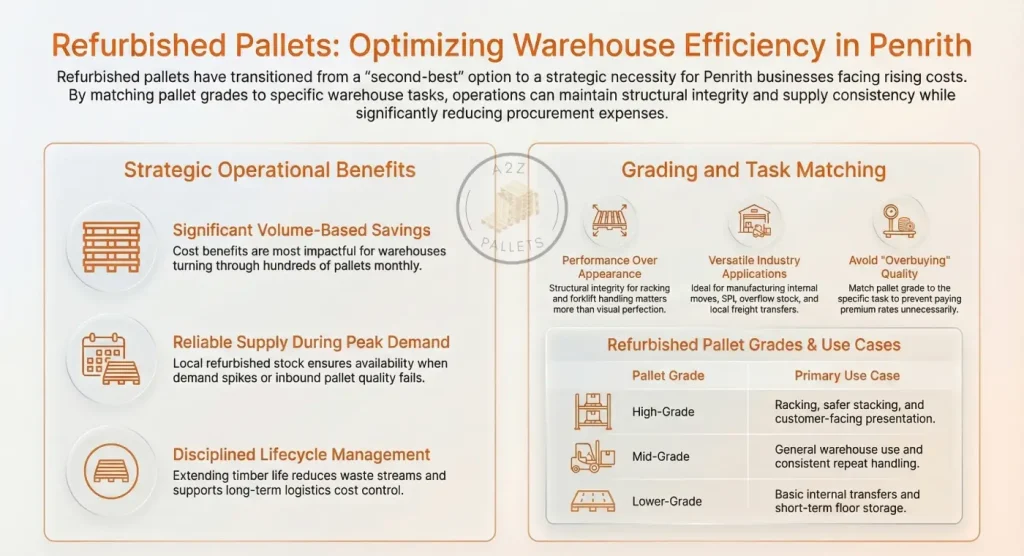
The cost case is usually the starting point. New units have their place, especially where strict export, retail presentation or specific engineering standards apply, but plenty of warehouse movements do not need a brand-new unit under every load. Refurbished stock can lower procurement costs while still doing the job required for storage, picking, internal transfers and local transport.
Most operators notice the savings over volume rather than on a single purchase. A warehouse turning through hundreds of pallets each month will feel the difference faster than a site ordering occasional top-ups.
Damage rates often rise during peak dispatch periods. Inbound stock can also arrive on mixed-quality units that need replacing before putaway. In these situations, refurbished stock helps soften cost pressure. In most cases, the focus shifts to structural integrity rather than visual condition.
There is also the hidden cost of overbuying quality you do not actually need. If a load is moving from one Western Sydney site to another, or from production to short-term warehouse storage, a fully new pallet may be unnecessary. In practice, matching pallet grade to the actual task is where warehouse efficiency improves. You are not paying premium rates for a basic movement problem.
It’s not perfect. Lower-priced pallets that are poorly repaired or inconsistently graded can create nuisance costs through pallet breakage, unstable stacking and extra labour on the dock. The saving only holds up when the supplier knows how to sort usable stock from stock that should never go back into circulation.
Environmental Benefits of Refurbished Pallets
Refurbished stock make sense from an environmental standpoint, but the practical value is in the pallet lifecycle rather than broad claims about sustainability. A sound timber pallet that is repaired and returned to use keeps material in circulation longer and reduces the number of units sent straight to disposal. That matters for busy sites generating a steady stream of damaged boards and broken bearers.
Pallet reuse also reduces the need to replace every damaged unit with a completely new one.
For businesses managing ongoing freight movements, warehouse transfers and production output, that supports more disciplined logistics cost control. Fewer pallets going into waste streams, fewer urgent replacements being ordered, and a more stable flow of usable stock back into operations.
On the warehouse floor, the environmental benefit tends to follow from sensible buying rather than idealism. If refurbished stock is reliable, people use it. When it is not, it gets pushed aside and the program falls over. That is why supply consistency and repair standards matter so much. Environmental value is real. It only holds up when the pallets perform in everyday conditions.
The Versatility of Refurbished Pallets in Different Industries
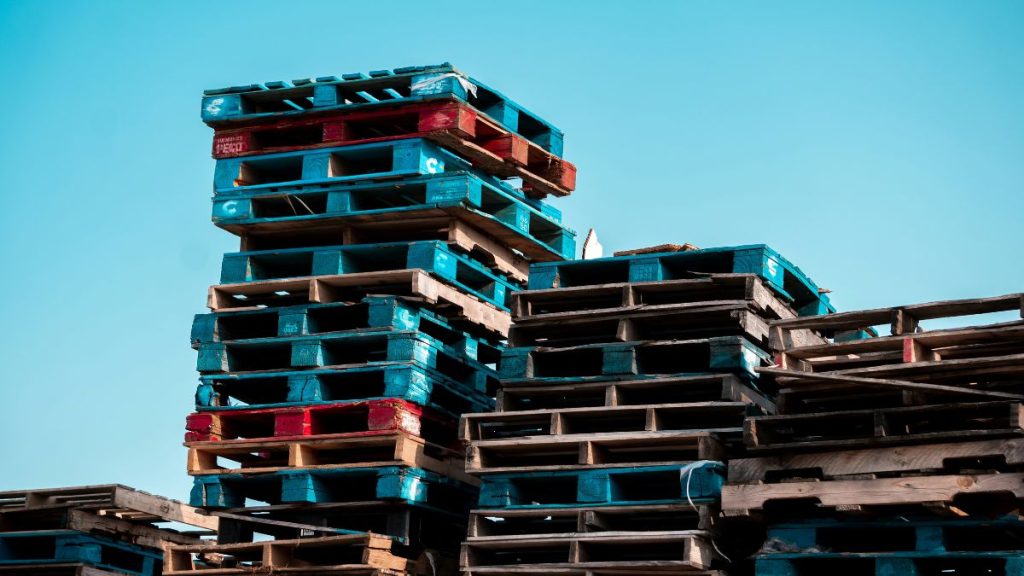
One reason refurbished pallets Penrith buyers keep coming back to is flexibility. They are used across manufacturing, warehousing, retail distribution, agriculture support, building products and 3PL networks because not every load profile is the same. A pallet used for bagged goods in a factory may not need the same finish or specification as one being sent into a customer-facing retail chain.
Manufacturers often use refurbished pallets for internal movements between production, staging and dispatch. 3PL operators may use them for overflow stock, short dwell inventory or one-way local freight. Exporters can use them in some parts of the operation too, though export compliance requirements must always be checked before shipment, especially when heat treatment or regulated formats are involved.
Container loading is another factor. Some operators prefer refurbished timber pallets for loads where standard dimensions, predictable entry points and manageable replacement cost matter more than appearance. Others use mixed pallet strategies, reserving higher-grade or specialised units for export or racking and lower-cost refurbished stock for floor staging and local transport.
There are trade-offs. Not every refurbished pallet suits every load, and no experienced warehouse manager assumes otherwise. The benefit is choice. A supplier that understands commercial use can help separate pallets for heavy product, general warehouse use, export-sensitive applications or cost-driven internal handling.
Not every pallet needs to look perfect. It just needs to work under load.
What types of refurbished pallets are available in Penrith NSW?
Most Common Pallet Materials: Timber, Plastic, and More
Timber remains the most common option in the refurbished market, largely because it is repairable, widely used and easier to source at scale. For many businesses looking to buy pallets Penrith suppliers offer, refurbished timber is the practical middle ground between price and function. It handles forklift access well, works across many warehouse environments and can often be repaired more economically than plastic alternatives.
Plastic pallets do appear in refurbished supply, though usually in more selective applications. They are useful where hygiene, moisture resistance or dimensional consistency is important, but they are not always the cheapest answer for general warehouse traffic. Damage can also be less straightforward to repair, which affects availability in the secondary market.
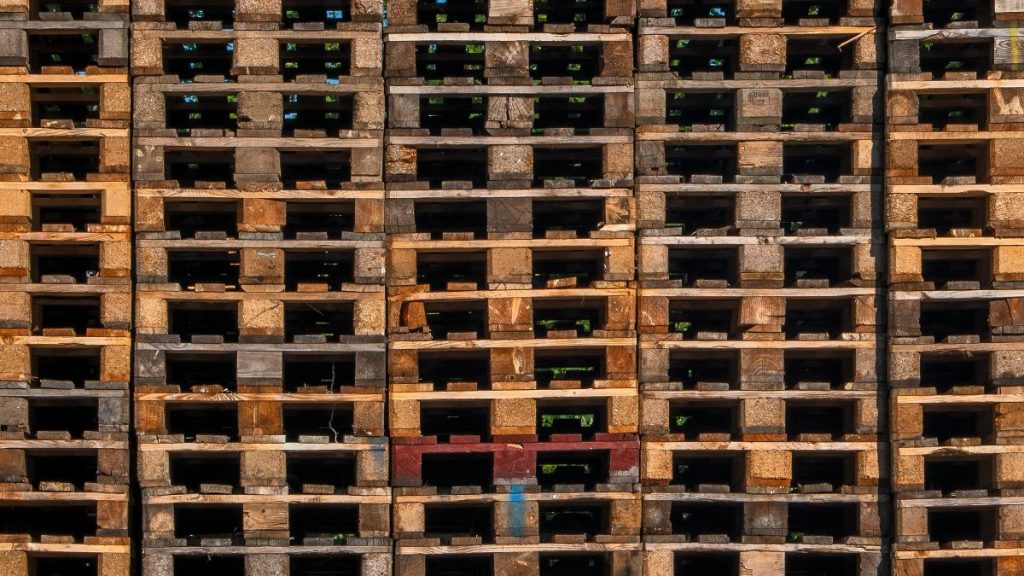
You may also see specialty pallet formats, skids or industry-specific designs depending on the supplier’s stock flow. The key issue is not material alone but suitability. A rough but sound timber pallet may be completely fine for local warehouse transfers, while a cleaner and more uniform unit may be needed for customer-facing freight or high-turn export preparation.
Most operators are not buying by material in isolation. They are buying by use case, handling conditions and acceptable risk.
Pallet Grades and Quality Options
Grade matters more than many buyers realise. Two refurbished pallets can look similar at a glance and behave very differently once they are loaded, double-handled by forklift and stacked under time pressure. That is why good suppliers sort stock by condition, repair quality and intended use rather than selling everything as one mixed batch.
Lower-grade pallets may suit basic, non-critical tasks such as internal transfers, short-term floor storage or lighter outbound movements. Mid-grade options often work well for general warehouse use where consistency still matters. Higher-grade refurbished stock is usually chosen when presentation, safer stacking or more reliable repeat handling is required.
On the warehouse floor, the weak point usually shows up fast. Loose deckboards, uneven repairs, protruding nails or inconsistent dimensions slow people down and create avoidable risk. A pallet that is technically cheap can become expensive once it damages stock or forces rework at dispatch. For that reason, asking about grading standards is not overkill. It is basic purchasing discipline.
This is where understanding structural integrity becomes more important than surface appearance.
Where to Buy Pallets in Penrith: Finding Reliable Pallet Suppliers
Overview of Local Suppliers of Refurbished Pallets
When businesses look to buy pallets in Penrith, reliability usually matters more than price alone. A supplier needs to have enough stock, clear grading, practical delivery options and some understanding of how pallets are actually used in warehouses and transport yards. If they cannot explain the difference between pallets for racking, local freight, and one-way use, that is a warning sign.
Competitive pricing matters, but most operators prioritise consistency and supply reliability over small cost differences.
Local sourcing helps. Shorter lead times can make a real difference when a site has a sudden spike in dispatch volume, an unexpected run of breakage or seasonal overflow that puts pressure on pallet holdings. Penrith operators often benefit from working with suppliers who already service Western Sydney and understand the pace of local industrial demand.
A2Z Pallets fits that conversation naturally, especially for businesses looking for consistent refurbished pallet supply in Penrith. That is what buyers usually remember. Not slogans. Just whether the pallets turned up, matched the brief and held together under load. Working with a supplier like A2Z Pallets can help ensure consistent supply.
Tips for Getting Cheap Pallets in Penrith
If your goal is to secure cheap pallet stock in Penrith without creating operational issues, start by being specific about the job. Tell the supplier what is being loaded, whether the pallets are going into racking, how often forklifts will handle them, and whether the load is staying local or moving further through the chain. General enquiries often get general stock.
It also helps to ask what grade is available consistently, not just what is available today. One-off bargains can look good until the next reorder arrives in a completely different condition. Supply consistency is part of cost control. So is reducing the time your team spends sorting through unusable units after delivery. This becomes more important when ordering in large quantities, where inconsistency creates immediate operational friction.
If you need to buy pallets Penrith warehouses will use across different tasks, consider splitting the order by application rather than chasing one uniform low price. Use better-grade pallets where the risk is higher, and more economical refurbished stock where the movement is simpler. That approach usually produces better value than buying the cheapest option across the board.
Are refurbished pallets worth it for warehouses in Penrith?
For most warehouse operations, refurbished pallets are worth it when matched correctly to the task. They reduce replacement costs, support consistent supply during demand spikes, and perform reliably for internal handling, local transport, and general storage.
The decision depends on usage. If pallets are used for export or high-spec retail environments, new pallets may still be required. But for day-to-day warehouse operations, refurbished stock offers a practical balance between cost and performance.
Conclusion
Refurbished pallets are not a shortcut. In practice, they work well when matched to the actual warehouse task. For Penrith warehouses and industrial operators trying to control costs without compromising day-to-day handling, refurbished stock can reduce spend, extend pallet lifecycle value and support smoother operations across storage, staging and outbound freight.
The real issue is not whether used pallets are cheaper. It is whether they are reliable enough for your environment. In practice, most warehouse teams focus on reliability, supply consistency, and suitability to the task.
If the grading is clear, the repairs are sound and the supplier can maintain stock when demand rises, refurbished pallets can be a sensible part of warehouse efficiency and long-term logistics cost control. For many operations, refurbished pallets Penrith suppliers provide become part of a long-term cost control strategy rather than a short-term saving.
If you’re reviewing your pallet supply strategy, it’s worth speaking with a local provider.
Questions:
Where can I buy refurbished pallets in Penrith?
You can buy refurbished pallets from local pallet suppliers Penrith NSW businesses use for warehouse, manufacturing and transport needs. The better option is usually a supplier that can explain grading clearly, maintain stock continuity and deliver pallets suited to your actual handling conditions. A2Z Pallets is one practical choice for businesses that want commercially reliable supply rather than mixed-quality stock.
How do refurbished pallets compare to new pallets in terms of cost and quality in Penrith?
Refurbished pallets are usually more cost-effective than new pallets for general warehouse use, local freight and internal handling, especially when bought in volume. Quality depends heavily on repair standards, grade and whether the pallet is matched to the task, so they should not be treated as interchangeable with new units in every situation. For many Penrith operations, the right refurbished pallet offers a sound balance between price, usability and supply flexibility.
