Australian Standard pallets are widely used across warehouses, manufacturing facilities, distribution centres and transport operations throughout Sydney and NSW. However, not every business has the same pallet requirements.
One of the most important decisions is choosing between Australian Standard light weight pallets and Australian Standard heavy weight pallets. While both options use the familiar 1165 × 1165 mm Australian Standard footprint, their suitability can vary depending on the weight of your products, how often the pallets are handled, storage conditions and transport requirements.
Choosing the right pallet can help businesses avoid unnecessary costs while ensuring their products are properly supported during storage, handling and transport.
What Are Australian Standard Pallets?
Australian Standard pallets are commonly used across Australian warehousing, freight and distribution networks. A2Z Pallets supplies both light weight and heavy weight options in the standard 1165 × 1165 mm format.
The main difference between these pallet options is their construction, load capacity and suitability for different operational requirements.
For businesses that need a cost-effective solution for everyday warehouse movement, Australian Standard Light Weight Pallets can be a practical option. For heavier products, repeated handling or more demanding industrial environments, Australian Standard Heavy Weight Pallets may be more suitable.
The right choice should always be based on the actual requirements of your operation rather than pallet weight alone.
When Are Light Weight Pallets a Good Option?
Australian Standard light weight pallets are designed for day-to-day warehouse, distribution and freight applications where extremely heavy loads are not required.
According to A2Z Pallets, its refurbished light weight pallets are 1165 × 1165 mm and are commonly used across warehousing, retail distribution, transport, manufacturing and commercial supply chain operations.
They may be suitable for:
- General warehousing
- Retail distribution
- FMCG stock movement
- Lighter freight loads
- Internal warehouse movement
- Pick-and-pack operations
- Seasonal inventory overflow
- Standard distribution requirements
A2Z Pallets lists its light weight Australian Standard pallets with a static load rating of up to 2,000 kg and a dynamic load rating of up to 1,000 kg, although specifications can vary depending on pallet grade and stock availability.
For businesses moving large volumes of lighter goods, choosing an appropriate light weight pallet can help avoid paying for heavier construction when it is not required.
When Do You Need Heavy Duty Pallets?
Australian Standard heavy weight pallets are intended for more demanding warehouse, manufacturing, freight and logistics applications.
They can be suitable for businesses handling:
- Heavy freight
- Bulk products
- Industrial materials
- Manufacturing components
- Construction supplies
- High-volume warehouse operations
- Repeated forklift handling
- Heavy products stored in warehouse racking
- Interstate freight and logistics
A2Z Pallets’ Australian Standard Heavy Weight Pallets use the 1165 × 1165 mm format and are designed for demanding warehouse operations, bulk freight, manufacturing and transport environments.
The current product information lists a static load rating of up to 3,000 kg and a dynamic load rating of up to 1,500 kg, with specifications potentially varying according to pallet grade, timber availability and refurbishment requirements.
Businesses can therefore consider heavy duty pallets when their products, storage systems or handling processes place greater demands on pallet strength and durability.
Light Weight vs Heavy Weight: What Is the Difference?
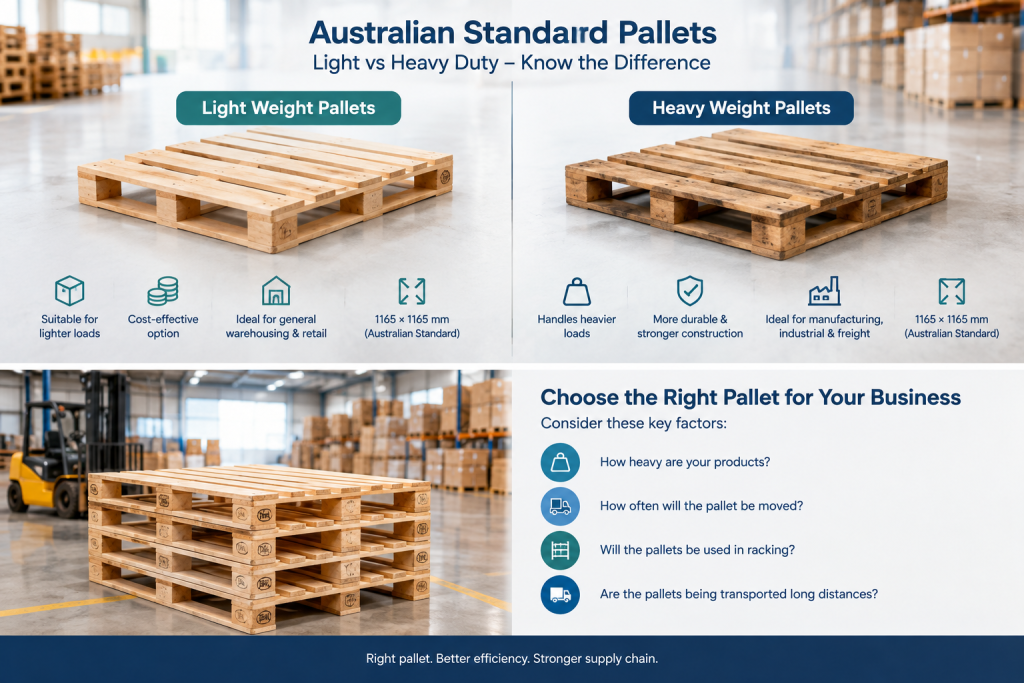
The choice between light and heavy pallets should not simply be based on the purchase price. Consider how the pallet will be used throughout its working life.
1. Consider the Weight of Your Products
The total weight of the goods is one of the first things to assess.
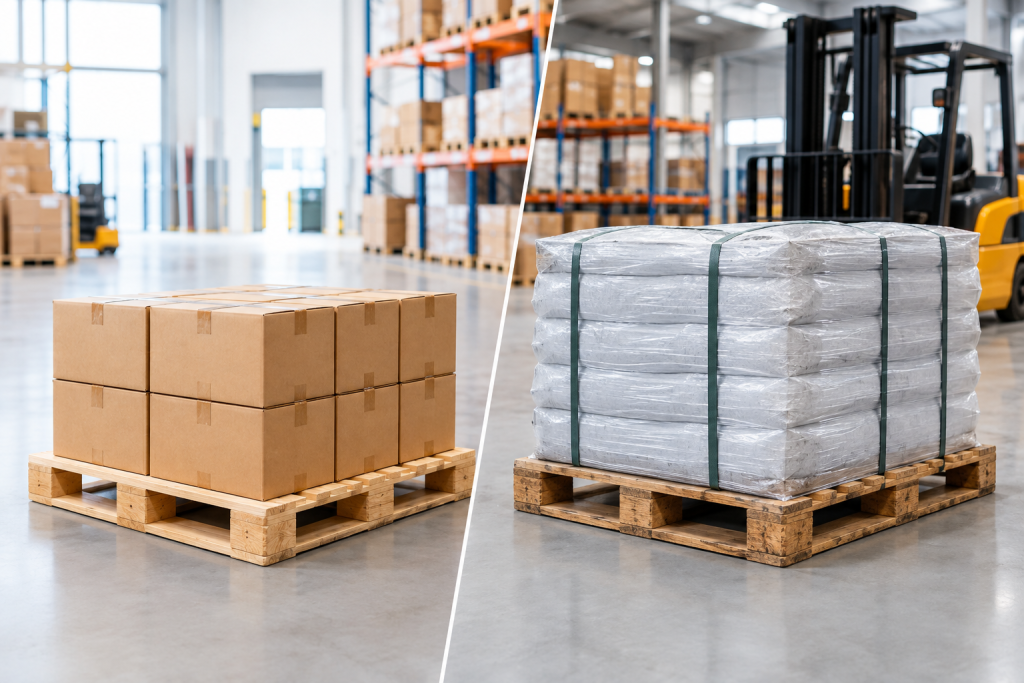
A pallet carrying lightweight cartons for retail distribution may have different requirements from one carrying building materials, industrial components or bulk products.
Before ordering, determine:
- The weight of a fully loaded pallet
- How the goods are distributed across the pallet
- Whether the load is stable or uneven
- How the goods are stacked
- Whether the pallet will be stored or transported while fully loaded
A pallet’s stated capacity should also be checked against the actual handling and storage conditions in your operation.
2. How Often Will the Pallet Be Handled?
Handling frequency can make a significant difference.
A pallet that is moved occasionally may experience less operational wear than one that is picked up by forklifts or pallet jacks several times a day.
If pallets are regularly moved between receiving areas, storage locations, production lines and dispatch zones, businesses should consider the durability and condition required for repeated handling.
For businesses with frequent pallet movement, reconditioned pallets can also provide a practical option when they have been appropriately inspected and are suitable for the intended application.
3. Will the Pallets Be Used in Warehouse Racking?
Warehouse racking can place specific demands on pallets.
If your pallets will be stored in racking systems, make sure the pallet type is compatible with your racking configuration, load and handling equipment.
A2Z Pallets lists both light and heavy Australian Standard pallets as suitable for warehouse and logistics applications, but actual suitability should be confirmed against your specific racking system and operating conditions.
4. How Frequently Are the Pallets Transported?
Pallets used for interstate freight, third-party logistics or frequent dispatch may experience repeated loading, unloading and forklift handling.
Consider the complete supply chain rather than only what happens inside your warehouse.
If a pallet is regularly:
- Loaded onto trucks
- Unloaded at distribution centres
- Moved between warehouses
- Handled by forklifts
- Stored in racking
- Reused for multiple freight cycles
then pallet construction and condition become particularly important.
Light Weight vs Heavy Duty Pallets: Practical Comparison
| Consideration | Light Weight Pallets | Heavy Weight Pallets |
|---|---|---|
| Typical use | General warehousing and distribution | Heavy freight and industrial operations |
| Common applications | Retail, FMCG and lighter goods | Manufacturing, bulk freight and heavy products |
| Handling | Standard warehouse movement | Frequent or demanding handling |
| Load requirements | Lower-weight loads | Higher-weight and bulk loads |
| Construction | Lighter refurbished timber construction | Heavier-duty timber construction |
| Warehouse use | Storage, staging and distribution | Industrial storage and demanding operations |
| Cost | Can be a cost-effective option for suitable loads | May cost more due to heavier construction |
| Best suited to | Everyday commercial requirements | More demanding commercial requirements |
The final selection should be based on your actual load, handling method, storage system and transport requirements.
Can One Business Use Both Light and Heavy Pallets?
Yes. A business does not necessarily need to use one pallet type for every application.
A warehouse may use light weight pallets for retail products and general distribution while reserving heavy weight pallets for bulk products, industrial materials or heavier freight.
For example:
- Retail stock → Light weight Australian Standard pallets
- General warehouse storage → Light weight pallets
- Heavy machinery components → Heavy weight pallets
- Construction materials → Heavy weight pallets
- Bulk industrial products → Heavy weight pallets
- Mixed warehouse operations → A combination of both
Using different pallet types according to the application can help businesses avoid over-specifying every pallet while still providing suitable support for heavier loads.
For businesses with several pallet requirements, custom pallet solutions may also be worth considering.
Reconditioned Pallets: A Practical Option for Sydney Businesses
New pallets are not the only option available to businesses.
Reconditioned pallets can be a practical choice for companies looking for reliable pallet supply while managing procurement costs. A2Z Pallets supplies reconditioned timber pallets across Sydney and NSW and quality-checks its Australian Standard light weight pallets for warehouse, freight and distribution applications.
The condition and grade of a reconditioned pallet should always be matched to the intended application. Businesses should consider the load, handling frequency, storage system and transport requirements before purchasing.
Choosing the Right Pallets in Sydney and NSW
Businesses looking for pallets in Sydney or across NSW should consider both their current requirements and expected future demand.
Ask yourself:
- What is the maximum loaded pallet weight?
- How often will the pallets be moved?
- Will forklifts or pallet jacks be used?
- Will the pallets be placed in racking?
- Are the pallets used for local or interstate freight?
- Do you need new, used or reconditioned pallets?
- Will you require regular or bulk pallet supply?
- Do you need heat-treated pallets for export?
A2Z Pallets supplies Australian Standard pallets as well as block, Euro, American and plastic pallet options across Sydney and NSW. Availability and specifications can vary according to stock and refurbishment requirements.
Planning for Bulk Pallet Supply
For warehouses, manufacturers and logistics operators, pallet requirements can change significantly during seasonal peaks or periods of increased production.
Instead of ordering pallets only when stock runs low, businesses with ongoing requirements may benefit from a planned bulk pallet supply arrangement.
A2Z Pallets provides bulk pallet supply for warehouses, manufacturers, logistics operators and other commercial businesses across Sydney and NSW.
Planning supply in advance can help businesses maintain consistent pallet availability and reduce disruptions to receiving, storage and dispatch operations.
Need Pallet Delivery Across Sydney or NSW?
Once you have identified the right pallet type, reliable delivery is another important consideration.
A2Z Pallets provides pallet delivery across Sydney, Western Sydney and NSW, supporting single, repeat and bulk delivery requirements for warehouses, manufacturers, logistics operators and commercial businesses.
When arranging delivery, consider the order quantity, site access, unloading requirements and the timing of your warehouse operations.
Making the Right Pallet Choice for Your Business
Choosing between light weight and heavy duty pallets comes down to how the pallet will be used.
Start by assessing your maximum load weight, handling frequency, warehouse racking requirements, transport conditions and expected pallet reuse. From there, you can determine whether Australian Standard Light Weight Pallets, Australian Standard Heavy Weight Pallets, or a combination of both is appropriate for your operation.
For businesses across Sydney and NSW, selecting pallets based on actual operational requirements can help improve warehouse efficiency, manage purchasing costs and maintain a more reliable supply chain.
Frequently Asked Questions
The commonly used Australian Standard pallet footprint is 1165 × 1165 mm. A2Z Pallets supplies both light weight and heavy weight Australian Standard pallets in this format.
Yes. Light weight Australian Standard pallets are commonly used for general warehousing, distribution, retail stock movement and lighter freight applications. The suitability depends on the actual load and handling conditions.
Heavy duty pallets may be appropriate when handling heavier products, bulk freight, industrial materials or goods that are frequently moved by forklifts and other warehouse equipment.
They can be used in warehouse and racking applications where the pallet specifications are suitable for the particular racking system, load and handling requirements. Always confirm compatibility with your warehouse setup.
Yes. Businesses can use different pallet types for different products and handling requirements. This can be useful where a warehouse handles both lighter retail products and heavier industrial or bulk goods.
