
Introduction
If you are running a warehouse or freight operation in Australia, pallets sit quietly under almost everything you move. You notice them most when they fail.
More operators are now looking seriously at refurbished pallets rather than assuming new timber is the only “safe” option. Price pressure, sustainability targets, and tightening pallet compliance in Australia are all part of that shift.
Done properly, refurbished pallets are not just a cheap stop-gap. They can be a controlled, spec’d product that fits AS 4068 pallet requirements and AS 4084 racking design. They can also meet ISPM-15 export rules when supplied by a competent provider. It’s not perfect. There are trade‑offs. But the benefits are usually bigger than most first‑time users expect.
Refurbished Pallets – Key Business Advantages
- Lower capital tied up in pallets while maintaining safe load handling.
- Reduced packaging and disposal costs through reuse and pallet recycling benefits.
- Smaller carbon footprint by extending timber life instead of buying new every cycle.
- Easier compliance with pallet standards and export rules when sourced from accredited providers.
- Support for local refurbishment, repair and recycling jobs rather than importing more new timber.
Standards Referenced in Australia
- AS 4068 – Flat pallets for materials handling: Defines design and performance for standard flat pallets used across Australian warehousing and transport.
- AS 4084 – Steel storage racking: Sets design and operational requirements for pallet racking, including how pallets interact with beams and load capacities.
- ISPM‑15 – International Standard for Phytosanitary Measures No. 15: Governs heat treatment and marking of timber packaging for export, including pallets.
- AWPCS – Australian Wood Packaging Certification Scheme: Australian scheme that licenses treatment providers and manufacturers to apply the ISPM‑15 export mark.
These are the touchpoints you should keep in mind when assessing refurbished pallets Australia wide.
Why reconditioned pallets is a smart business move? – A2ZPallets AU
From a business perspective, pallets are rarely a strategic line item on the balance sheet. Yet they touch every order you dispatch and every container you load. That’s exactly why reconditioned pallets can quietly tidy up several problems at once.
Most operations using refurbished pallets report three early wins: less capital tied up in wooden assets, fewer loads rejected for pallet condition on domestic legs, and less time spent organising scrap or disposal. For a 3PL with seasonal spikes, flexibility matters. You can increase or reduce pallet numbers without paying new-pallet rates for every extra load. That benefit often outweighs sustainability claims.
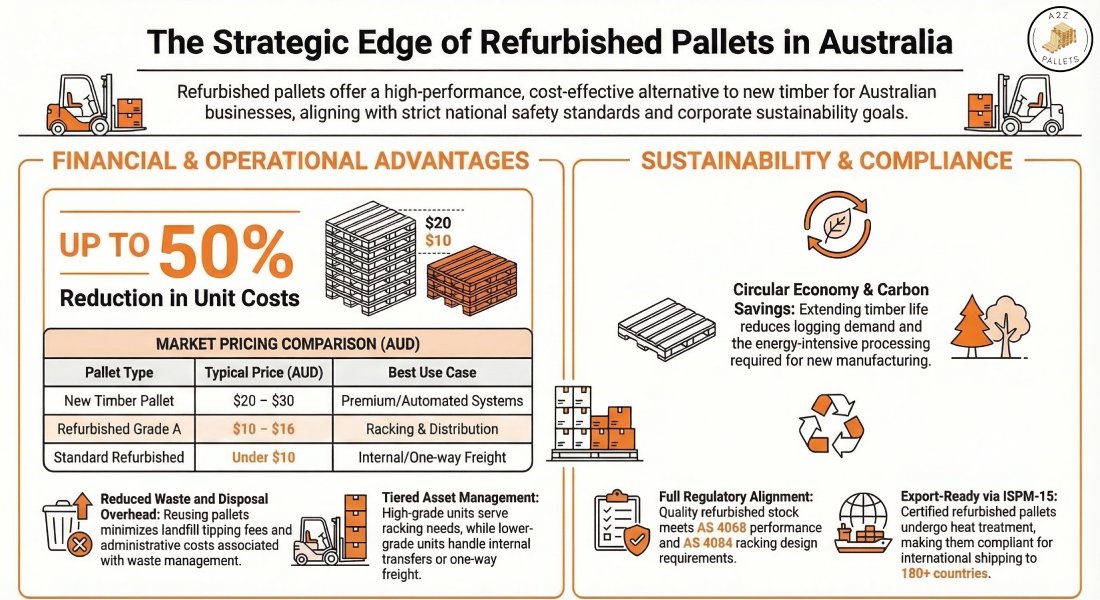
You also keep options open. High‑grade refurbished pallets can be reserved for racking and repetitive use, while more heavily marked units can move to internal transfers or one‑way freight. In practice, that kind of tiered pallet policy is much easier to afford when your base stock is refurbished rather than all‑new.
In a typical cross-dock environment, pallets are dropped, dragged, clipped by fork tines and left outside in weather. If a refurbished pallet survives that cycle, it has already proven more than a showroom-new unit ever has.
If you want to understand more about how pallet grading, recycling, and supply works in practice, you can explore more about A2ZPallets and how we approach refurbished and new pallet supply across Australia.
Cost Savings and Financial Advantages of Refurbished Pallets
Lower Upfront Investment Compared to New Pallets
The most obvious benefit of refurbished pallets is the unit price. In the Australian market, new timber pallets often sit in the 20–30 AUD range. Refurbished Grade A pallets are commonly available around 10–16 AUD, depending on grade and volume. When you buy in hundreds or thousands, the difference is immediate.
That price gap exists because the timber in refurbished pallets has already been harvested and processed. The refurbisher is paying for collection, repair and grading rather than full manufacturing. For you, the net result is the same footprint and comparable performance for significantly less capital outlay per pallet.
Reduced Packaging and Shipping Expenses
The cost story does not stop at the pallet invoice. Reusing pallets cuts down on your waste stream and the associated disposal charges. Australian guides on second‑hand pallets point out that sending fewer pallets to landfill reduces both direct tipping fees and the admin overhead around waste contractors and reporting.
If refurbished pallets are correctly sized and within AS 4068 tolerances, they integrate cleanly with your racking and handling equipment. That means fewer handling delays at the dock, fewer repalletising jobs when a damaged pallet arrives at a customer site, and less transport damage from undersized or non‑standard units. A forklift driver not having to re‑stack a leaning palletised load saves more money than many managers realise over a year.
Predictable Pricing for Bulk Purchases
Refurbished pallets also help smooth out price volatility. New pallet prices track timber markets closely, and that has been particularly noticeable after bushfires and supply constraints in local plantations. Refurbishment uses existing timber in circulation, so while labour and fuel still matter, the pure material exposure is lower.
Many refurbishers in Australia offer sharper pricing again for large, regular orders, which lets you forecast pallet spend with fewer surprises across the year. For a procurement team, that predictability can be just as valuable as the initial unit saving when you are bidding on long‑term contracts with tight margins.
Environmental Sustainability: The Green Benefits of Used Pallets
Reducing Waste and Supporting Recycling Initiatives
Every time you buy a refurbished pallet instead of new, you are extending the working life of that timber. Australian recyclers emphasise that pallet recycling benefits include lower landfill volumes, reduced timber waste and less pressure on forests for new pallet production.
The refurbishment process includes collection, sorting, repair and regrading. It turns what could be waste into a usable asset again. In real warehouse conditions, that is as simple as your “damaged pallets” stack turning into feedstock for someone else’s refurbished stock, rather than a bin full of broken boards.
Lower Carbon Footprint and Resource Conservation
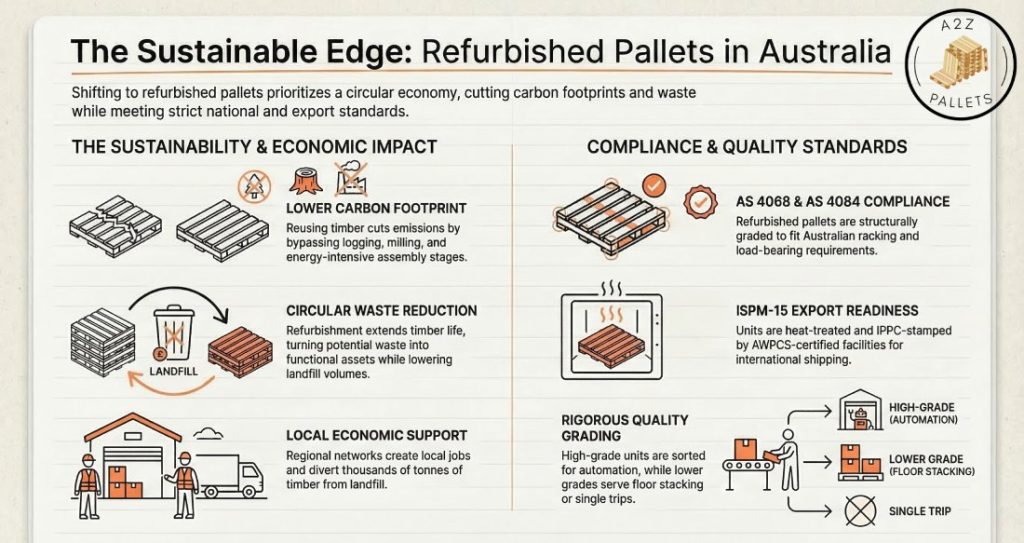
Manufacturing new pallets consumes energy at every stage: logging, milling, drying, transport, assembly. Refurbished pallets Australia wide cut out large parts of that chain by reusing existing timber, which directly reduces associated emissions.
Several Australian pallet recyclers highlight lower carbon footprint as a core outcome – fewer trees harvested, less combustion of diesel and electricity in processing, and less timber decomposing in landfill releasing carbon. For businesses reporting under ESG or modern slavery disclosures, being able to show credible reuse of materials in logistics is a small but useful line in sustainability reporting.
Compliance with Industry Standards
Refurbished pallets still have to live in the same world of pallet compliance Australia operates under. That means fitting physically and structurally into AS 4068 pallet definitions, behaving predictably in AS 4084‑designed racking, and meeting ISPM‑15 rules if they are used for export.
A good refurbisher builds their processes around these benchmarks: grading out units that no longer meet load or dimensional criteria for racking, heat‑treating export pallets in AWPCS‑certified facilities, and marking pallets correctly so border staff recognise them.
Standards matter. But day-to-day performance matters just as much.
International Shipping Compliance
For export work, ISPM‑15 pallets are essential. ISPM‑15 requires all solid wood packaging thicker than 6 mm to be heat treated or fumigated and then marked with the IPPC stamp. Under the AWPCS framework, only approved Australian providers can apply that mark, and they are audited to maintain standards.
Refurbished pallets can go through the same treatment. Once heat treated and certified, they function as export‑ready ISPM‑15 pallets, suitable for use into 180+ countries that enforce the standard. For a business, that means you can still realise cost savings refurbished pallets bring without giving up market access or risking holds at foreign ports.
Industry-Specific Requirements
Different sectors lean on different parts of the standard set. Food and FMCG operators are often more focused on how pallets behave in AS 4084‑compliant racking systems, and on clean, splinter‑free decks for shrink‑wrapped product. Heavy industry cares more about concentrated loads and how pallets behave on beams or in drive‑in racking.
Refurbished pallets can be graded accordingly. Higher‑grade units go into selective racking or automation. Lower‑grade ones may be restricted to floor stacking, internal moves or single trips with non‑fragile goods. When a supplier understands your industry profile, they can label and segregate refurbished stock clearly. This helps match pallets to your risk tolerance.
Stringent Quality Control
Refurbishment is not just a quick nail‑gun job when it is done properly. Typical Australian recycling operations sort incoming pallets by size and condition, replace damaged boards with sound timber, remove protruding fasteners, and then re‑grade to defined quality levels before resale.
ISPM‑15 and AWPCS add another layer for export pallets, requiring documented treatment processes and regular audits of facilities. From a buyer’s perspective, that structured quality control is what separates commercial refurbished pallets from “whatever the driver picked up from the back of a store”.
Documentation and Certification
For many larger customers, especially in export and food, paperwork matters almost as much as the pallet. ISPM‑15 guidance for Australian exporters notes that treated timber packaging should have traceable documentation – treatment records, facility IDs, and in some cases batch certificates – to back up the stamps on the wood.
A capable refurbished pallet supplier will be able to issue statements of compliance, treatment certificates for export batches, and specifications that link your pallet grades back to AS 4068 and racking requirements. That documentation helps you respond quickly when a customer, auditor or regulator starts asking detailed questions.
Reducing Carbon Footprint
Although it sits under “compliance” here, many businesses now treat emissions almost like another standard to hit. Recycling and refurbishing pallets is consistently listed as a practical way to reduce carbon output, particularly when you combine it with local sourcing and recovery programs.
You will not solve your Scope 3 challenges with pallets alone. But replacing a steady stream of new timber with refurbished stock is an easy, defensible change for sustainability reports and customer tenders.
Support for Local Economies and Community Impact
Refurbished pallets are typically a local business. Australian refurbishers collect, repair and resell pallets within state or regional networks, employing local staff and often partnering with timber recyclers to turn irreparable pallets into mulch, animal bedding or biofuel.
Choosing refurbished pallets therefore keeps more of your spend within local supply chains. It also reduces reliance on imported timber products and supports recovery programs that divert thousands of tonnes of timber away from landfill each year.
Quality, Reliability, and Safety of Refurbished Pallets
Inspection and Refurbishment Process Ensuring Durability
A well‑run refurbishment line is almost obsessive about inspection. Pallets are checked for split bearers, broken or loose deck boards, protruding nails and moisture or contamination, then either repaired, downgraded or scrapped.
Repair teams often use reclaimed hardwood or sound sections from other pallets. This makes refurbished units extremely durable in everyday forklift handling. In many mixed warehouses, operators report that high‑grade refurbished pallets last multiple cycles before needing touch‑up work again, especially when drivers are trained not to drag forks through decks or push pallets along concrete.
Meeting Compliance Standards for Safe Transportation
Safety is where refurbished pallets either succeed or fail. When they are matched to their appropriate roles, they can comfortably meet the requirements of AS 4068 for pallet strength and fit neatly into AS 4084‑compliant racking layouts.
A2ZPallets NSW specifically points managers to AS 4068 and AS 4084 when assessing racking and pallet interactions, which applies whether those pallets are new or refurbished. For you, the key is to work with a supplier who grades pallets clearly, labels them where necessary, and is honest about which applications they are – and are not – suitable for.
If you’d like to discuss your current pallet setup or pressure-test whether refurbished stock makes sense for your operation, you can contact A2ZPallets for a practical, no-obligation conversation.
Conclusion
Refurbished pallets aren’t a silver bullet.
But in most Australian warehouses, they solve more problems than they create.
The value comes from treating them as a specified product with known grades and limits, not as “whatever second‑hand we can find”.
The real benefit isn’t that refurbished pallets are cheaper.
It’s that they let you spend money where it actually improves your operation.
Questions (Benefits of refurbished pallets):
Refurbished pallets typically cost significantly less per unit than new timber pallets, often around half the price in Australia for standard sizes. They also extend the life of existing timber, reducing waste to landfill and pressure on forests.
You save immediately on purchase price, and then again by reducing the rate at which pallets are scrapped and replaced. Reusing pallets also cuts disposal and landfill costs, which Australian recyclers note can be a material line item for high‑volume operations. Correctly sized refurbished pallets integrate with standard racking and transport, avoiding repalletising work and product damage that quietly inflate packaging and freight costs.
When sourced from a professional refurbisher with defined grading and repair standards, refurbished pallets are inspected, repaired and regraded before reuse, which restores structural reliability for everyday freight. They can be matched to applications that suit their grade – higher quality for racking and automation, lower grades for floor‑stacking or internal moves – while still operating within AS 4068 and AS 4084 frameworks. As with new pallets, regular on‑site inspections and sensible forklift handling are still essential.
Refurbished pallets keep usable timber in circulation longer, which directly reduces landfill volumes and demand for new logging and milling. Recycling programs also turn end‑of‑life pallets into mulch, animal bedding or biofuel, further improving resource efficiency. For businesses reporting on emissions and sustainability targets, using refurbished pallets Australia wide is a practical, defensible example of circular economy thinking in the supply chain.
