
Introduction
Most Australian warehouses are trying to squeeze more out of every dollar and every square metre. Used or refurbished pallets look like an easy win on both cost and sustainability. They usually are.
But when businesses treat second‑hand pallets as a commodity and skip the checks, problems show up quickly: damaged stock, bent beams, compliance questions and the odd near‑miss when a pallet lets go six metres up a rack. In real warehouse conditions, those “savings” disappear fast.
In most supply chain environments, pallets move through multiple stages — inbound shipping, storage in pallet racking, order picking and outbound transport. When pallet quality varies too much, small defects can ripple through the warehouse system and slow operations. Many warehouses rely on used pallets in Australia to reduce costs, but buying them without proper inspection can create safety and compliance risks.
Refurbished Pallets – Key Business Advantages
- Lower purchase cost than new while still supporting pallet compliance Australia requires when sourced correctly.
- More trips out of each piece of timber, unlocking clear pallet recycling benefits and less landfill.
- Flexibility to scale pallet numbers up during seasonal peaks without buying a full fleet of new.
- Potential to meet export and hygiene requirements with treated and graded refurbished pallets Australia wide.
- Support for local refurbishers and repair teams rather than importing more timber than you need.
Used pallets can work very well. They just need to be treated as an engineered part of your system, not a random piece of wood under the load.
Risks When Buying Used or Recycled Wooden Pallets in Australia
Common Mistakes Businesses Make with Second-Hand Pallets
The first big mistake is buying purely on price. Cheap mixed‑lot pallets from classifieds, surplus auctions or “free pallets” stacked outside retail sites might look fine from the forklift, but you have no real idea of their load history, treatment, or previous damage. You are effectively dropping unknown components into a system that’s supposed to follow AS 4068 for pallets and AS 4084 for racking.
Another common error is assuming anything called an “Australian standard pallet” is automatically suitable for racking. Standard size in Australia is typically 1165 x 1165 mm, but recycled stock can be light‑duty, heavy‑duty, or re‑blocked, and not every version is appropriate for high‑bay or drive‑in systems. Operators regularly discover this the hard way when deck boards bow on the beams or blocks punch through under point loads.
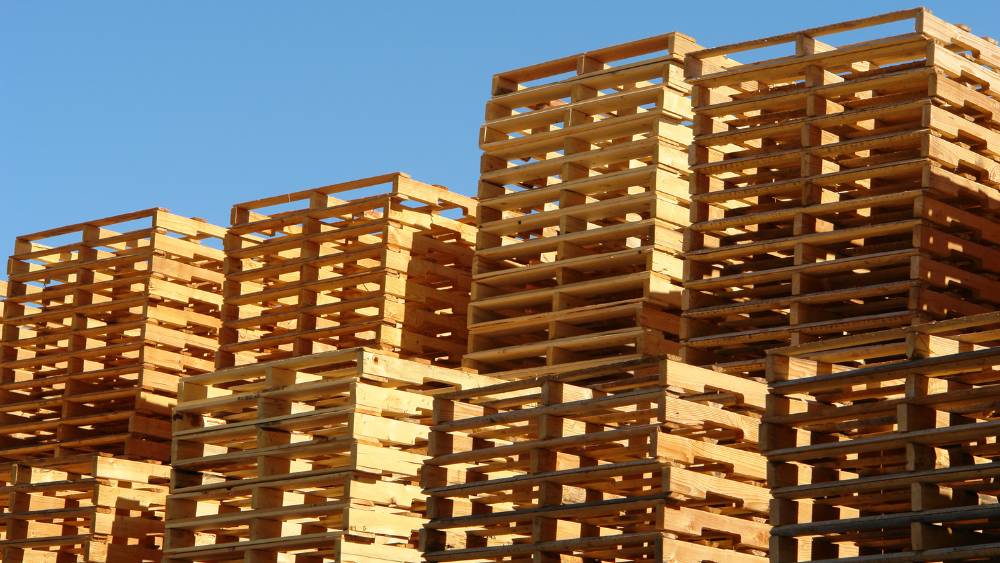
Mixing Different Pallet Types in Warehouse Operations
A third issue is mixing whatever used pallets arrive on site straight into export or food applications. Without checking ISPM‑15 treatment stamps or contamination, you risk non‑compliance at the border or chemical stains turning up under retail‑facing cartons. It only takes one untreated pallet in a container for a quarantine hold to wipe out the “benefits of refurbished pallets” for that whole shipment.
Finally, many businesses never define grades or usage rules for used pallets. Everything from near‑new refurbished pallets to patched‑up scrap ends up in the same stack. Drivers grab whatever is closest for racking, block‑stacking or container loading. That lack of segregation is where a lot of avoidable failures start.
Why Due Diligence Is Essential Before Purchasing
Used timber units come with a history. You just rarely see it. A pallet might have been overloaded, left in the weather for years, or exposed to chemicals that don’t show up at a glance. Without some due diligence, you inherit every one of those unknowns.
SafeWork NSW specifically points warehouse operators back to AS 4068 (flat pallets) and AS 4084 (racking design and operation) when they talk about safe storage systems. If you bring in second‑hand pallets that don’t sit properly on beams, don’t meet load expectations, or haven’t been treated correctly for export, you are now well away from those benchmarks.
For procurement teams managing a busy supply chain, that level of checking becomes part of normal pallet purchasing practice rather than a special inspection step.
Practical due diligence is not complicated. It’s things like insisting on a reputable refurbisher, asking how they grade and repair, checking sample pallets against your racking and forklifts, and confirming treatment and certification for any export work. Done once, that groundwork gives you a much safer pathway to enjoy the real benefits of refurbished pallets without gambling with pallet compliance Australia requires.
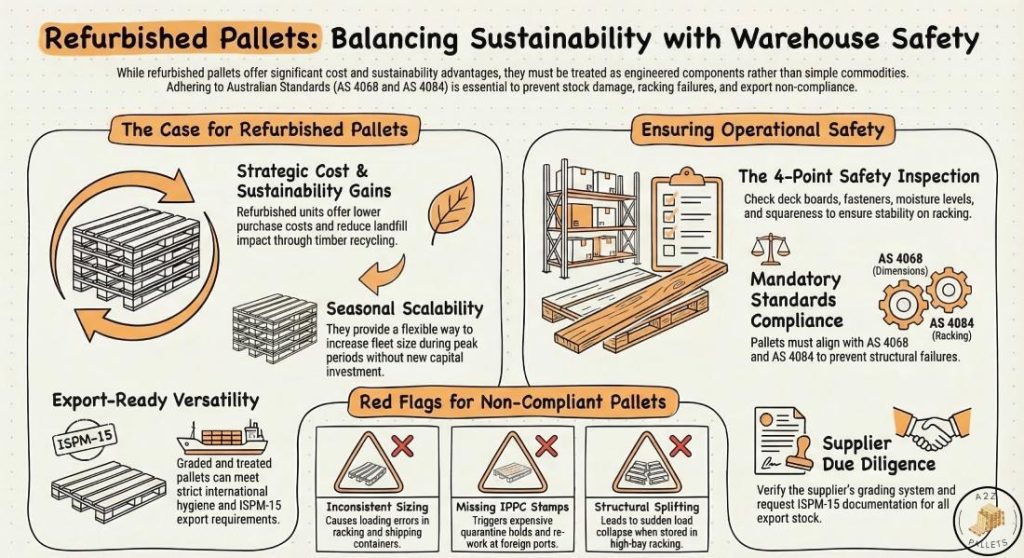
How to Inspect Used Pallets for Safety and Reliability
Physical Signs of Damage and Wear to Look For
A quick walk‑past glance is not enough. Most warehouse teams handle thousands of wooden pallets every week, so small structural defects can easily be missed unless someone is deliberately checking for them. A proper inspection of used pallets should cover at least a few basics every time:
- Deck boards and bearers: Look closely for cracked or broken boards, crushed bearers where forklifts have hit the entry points, and boards that have pulled away from the nails. Even a small split across a bearer can become a full failure once you put a tonne of stock on top.
- Fasteners: Protruding or rusty nails are one of the most common issues on recycled pallets and a frequent cause of hand injuries and torn product. Nails should be seated firmly; if you can move a board with your hand, that pallet needs repair or rejection.
- Moisture and contamination: Wet, mouldy or heavily stained pallets are trouble. Moisture above about 20–22% weakens timber and encourages mould, and unusual stains can indicate previous chemical spills. Those units should be kept away from food, pharma, and clean‑pack goods at a minimum.
Softwood pallets tend to absorb moisture faster than hardwood units, which can affect durability if they sit outside for long periods. - Warping and squareness: Put a pallet on flat concrete. If it rocks, twists or sits visibly out of square, it will never sit properly on racking beams or in tight export container patterns. That’s where you see loads leaning, stretch‑wrap tearing and beams picking up uneven forces.
For export or quarantine‑sensitive work, treatment stamps matter too. Look for the IPPC mark with “HT” (heat treated) and avoid recycled pallets with “MB” (methyl bromide) where your customers or internal policies prohibit that treatment. No stamp and no paperwork is a red flag for overseas use.
Typical Uses for Different Grades of Refurbished Pallets
| Pallet Grade | Typical Use in Warehouses |
|---|---|
| Grade A refurbished pallets | Suitable for pallet racking and repeated warehouse handling |
| Grade B refurbished pallets | Internal warehouse transport and short distribution runs |
| Heat-treated pallets | Export shipments requiring ISPM-15 compliance |
| Repaired recycled pallets | One-way shipping or non-critical loads |
Questions to Ask Your Supplier About Used Timber Pallets
If you are buying in any volume, what you ask your pallet supplier is just as important as what you see on the yard. A few targeted questions usually separate serious refurbishers from casual resellers:
- Where are these pallets sourced from, and how are they sorted and graded?
- What are your standard grades (for example, Premium / A / B) and how do they differ in deck condition, repairs and expected use?
- Do your refurbished pallets meet the dimensional and performance principles in AS 4068 for the sizes we are buying?
- Which grades are suitable for racking designed to AS 4084, and which should be limited to floor stacking or one‑way use?
- Can you provide ISPM‑15 compliant stock with HT‑stamped blocks and documentation for our export lanes?
You can turn these into a simple internal checklist titled “Quality Standards When Buying Recycled Pallets” and keep it with your purchasing templates. In practice, most reputable suppliers are happy to show you their repair process, quality checks and sample pallets. If you start getting vague answers, or nobody on their side can talk to standards or load expectations, that’s your cue to slow down. Serious refurbishers usually publish pallet specifications for each grade so warehouse teams know exactly what they are receiving.
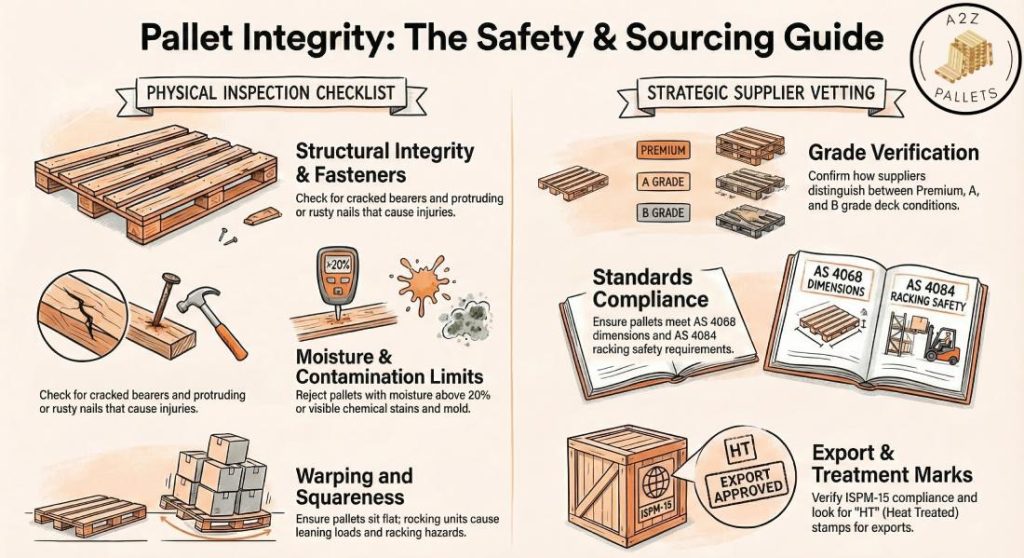
Meeting Quality Standards When Buying Recycled Pallets
Certification and Regulatory Compliance in Australia
Used or not, pallets are part of a regulated system. AS 4068 sets dimensional and performance requirements for flat pallets, including the common 1165 x 1165 mm Australian standard timber pallet. AS 4084 covers the design, operation and maintenance of steel storage racking that those pallets sit in.
Industry groups such as the Australian Logistics Council frequently highlight pallet integrity as a key warehouse safety factor. Businesses using used pallets in Australia for export shipments must ensure pallets meet ISPM-15 treatment and certification requirements.
On the export side, ISPM‑15 governs how solid wood packaging must be treated and stamped to move across borders, and Australian exporters are expected to follow those rules. Refurbished pallets can fully participate in this system when they are heat treated by accredited providers, stamped correctly, and supported with treatment records. That’s where the real pallet recycling benefits show up: you keep using the same timber, but still clear customs and quarantine checks. Heat treatment reduces the risk of pests or mold travelling with wooden pallets during international shipping.
Red Flags That Indicate Inferior or Non-Compliant Pallets
There are a few warning signs that suggest the used pallets in front of you are not worth the risk. None of these are theoretical; they show up regularly on Australian sites:
- No clear story about origin or grading. If a seller cannot explain where pallets came from, how they were sorted, and what their grades actually mean, you are relying on luck rather than standards.
- Inconsistent sizing in “standard” stacks. A stack labelled as recycled Australian standard pallets that contains 1165 x 1165, 1100 x 1100 and odd Euro sizes mixed together will cause headaches at every stage – racking, trucks, and export containers.
- Obvious structural damage being passed off as “minor”. Large cracks through bearers, missing blocks, extensive rot and repeated patch‑ups with short offcuts all point to pallets near end of life. These should be stripped for parts or chipped, not reused under stock.
- No treatment stamps on pallets offered for export. If you are told pallets are “export grade” but there is no ISPM‑15 IPPC stamp and no paperwork to back it up, assume they are not compliant. Container holds and re‑work at foreign ports are far more expensive than buying proper ISPM‑15 pallets in the first place.
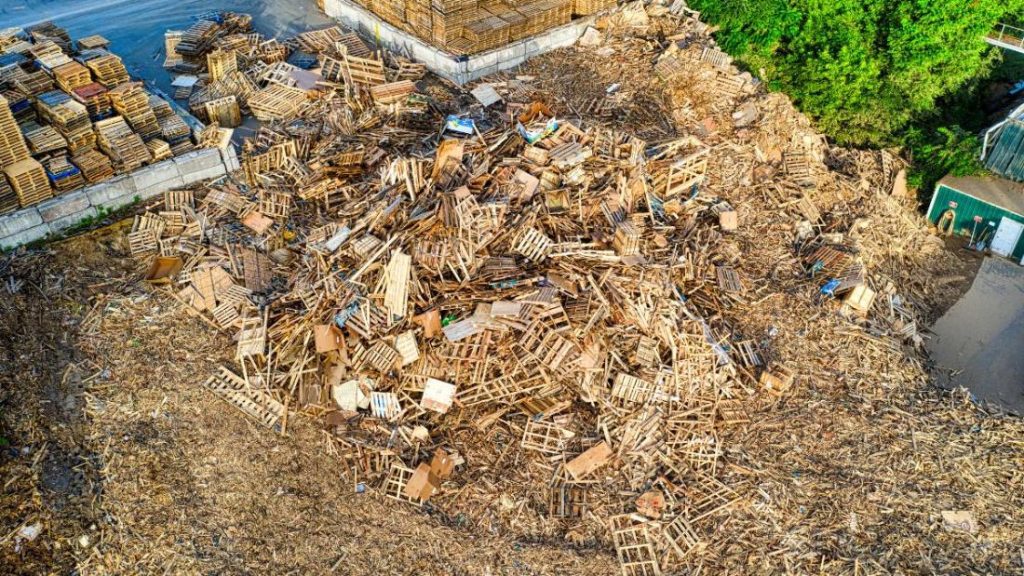
There are trade‑offs here. You can absolutely chase the lowest possible pallet price, but each red flag you accept shifts risk back onto your business, your people and your stock. Setting a clear floor under quality and compliance is usually cheaper than dealing with the fallout.
What Should Businesses Check Before Buying Used Pallets?
Before buying used pallets, businesses should check pallet dimensions, structural condition, timber treatment stamps, and whether the pallets suit their racking and load requirements. Verifying supplier grading systems and refurbishment practices also helps maintain pallet compliance Australia requires.
When sourced carefully, used pallets in Australia can be reliable assets rather than a warehouse liability.
If you’re reviewing your pallet setup or thinking about moving to refurbished pallets, it’s worth understanding how grading, repairs and compliance standards work in practice. You can explore how A2ZPallets approaches refurbished pallet supply across Australia here.
Conclusion
Used pallets are not the problem. Uncontrolled used pallets are. When refurbished pallets Australia wide are sourced from proper recyclers, inspected against sensible criteria, and slotted into your operation with clear rules, the benefits of refurbished pallets are very real. Lower unit cost, better use of timber, and a straightforward way to support your sustainability goals.
The flip side is just as real. Buying mixed second-hand pallets without checks or links to standards creates risk. It often means importing someone else’s pallet problems into your warehouse. If you treat used pallets as part of a system — with defined grades and inspection routines — they stop being a gamble. They start behaving like any other engineered asset in your warehouse.
